When they refuse vegetables
Why this happens
Refusing vegetables at this age is common, and it says little about how your child will eat in the long run. Somewhere between one and three, children start working out which foods feel safe, and a food that went down fine yesterday can look worth pushing away today. Usually it is less about taste than about texture, color, or the feeling of not being in charge of what goes in their mouth.
Pressure tends to make the pattern louder rather than quieter. Praising a bite, hiding vegetables inside other food, or saying "just one" turns a plate into a negotiation, and a child this age is built to hold their ground in a negotiation. It also helps to read a refusal as "not right now" rather than "never". Most children need to see an unfamiliar food many times before they will touch it, let alone eat it.
What to try this week
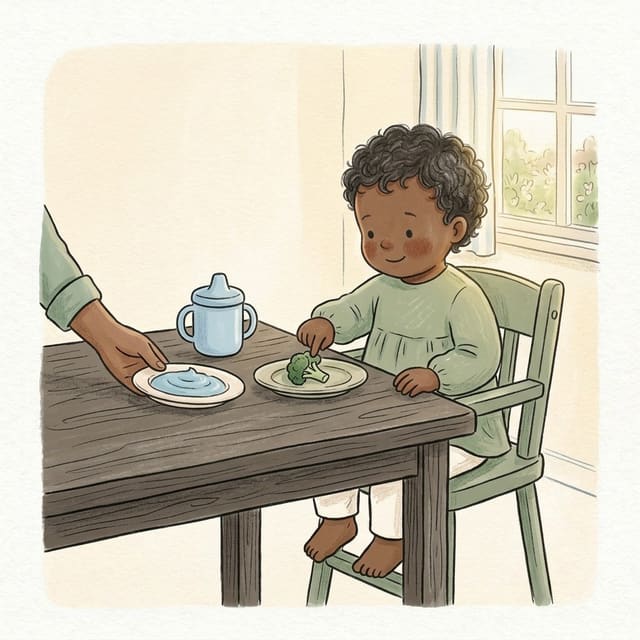
Put a small amount of one vegetable on the plate at every meal, next to a food you already know your child eats. Not as a swap, just as company. Serve it the way you eat it yourself, and eat yours without commenting on whether they touch theirs.
If they poke it, sniff it, or shove it to the edge, count that as part of getting used to it. You are not fishing for a bite. Keep the portion tiny, and keep offering the same one or two vegetables for a few weeks rather than rotating through new ones, because familiarity is what does the work here. If an older sibling or another adult eats the same thing at the same table, that tends to land harder than anything said directly to your child.
What not to worry about
A plate that comes back untouched is not a wasted meal. Children eat unevenly across a week rather than evenly across a day, and one big lunch can sit next to two picked-at dinners without anything being wrong. You do not need to label foods good or bad, and you do not need a reward chart.
It is also fine to stop. If a meal turns into a stand-off, end it calmly, take the plate, and try again at the next one. Nothing is lost by walking away from a bad twenty minutes.
When to ask someone
Talk to your pediatrician if your child is losing weight, dropping whole food groups, gagging or choking often, or if mealtimes are causing real distress at home. They can look properly at growth and nutrition, which is not something to guess at from a website.
It is also worth asking if the list of accepted foods has been shrinking rather than holding steady, or if your child seems frightened rather than uninterested when something new appears. Bring a rough note of what they have eaten over a few days, since that is far more useful than trying to remember it on the spot. Asking early is not making a fuss, and it often just means being told that what you are seeing is ordinary.
Try this together
Where this comes from
Little Wins guides are general information for parents, not medical or nutrition advice. If you are worried about your child's eating, growth or health, talk to your pediatrician.
More food guides
Browse
Food and mealtimes guides · All guides · Activities · Everyday helper activities · Sensory activities