For nurseries, schools, family hubs and childminders

A play programme
your families will
actually do.

Little Wins at Home gives parents of two to four year olds three short play ideas a week. Each takes five to ten minutes, uses nothing they have to buy, and fits a moment the family already has: bath time, the walk in, waiting for tea. No screens for the child, and nothing for your staff to run.

We are bidding for Innovate UK and Department for Education funding to run it with West Midlands settings from February 2027, free to settings and families. If you would like your families included, backing us takes two minutes.

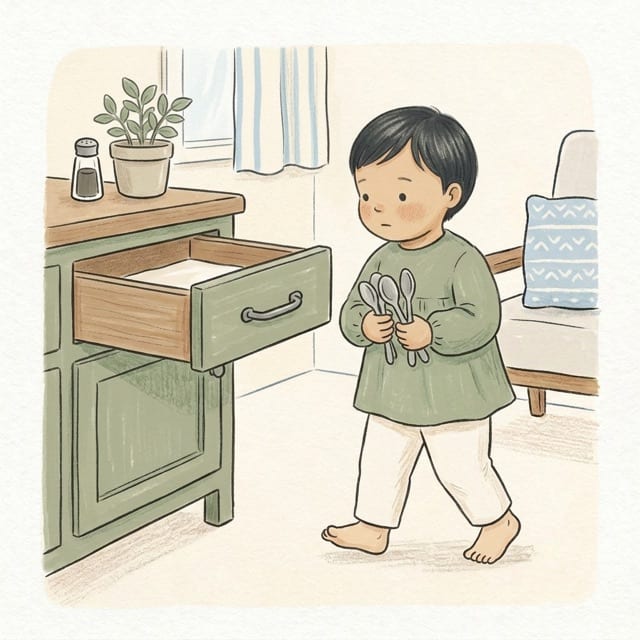
A toddler carefully carrying a handful of cutlery to the table

What your families get

Parents tell nursery staff the same thing every week: they want to play more, but by six o'clock there is no time, no ideas and no energy left. So the programme makes play small enough to fit the day they already have.

Three ideas a week

Five to ten minutes each

Every idea is written to be done once, today, without planning. "At bath time, name each bit as you wash it. Skip one and see if they tell you."

Nothing to buy

A sock, a cup, the stairs

Ideas use what is already in the home, so they work in a flat with no garden as well as a house with one. No printing, no craft shop, no Pinterest.

Printed first

A pack that goes home

Families get a printed 12-week pack in their own language, each week mapped to the EYFS prime areas. Parents who want it can also have the ideas on their phone, but the play itself is always face to face, and the child never uses a screen.

What your setting gets

Every setting has a duty to support learning at home, and almost nothing to point to. This gives you a named programme, numbers, and an independent evaluation you can quote.

Reach

It goes home with the child, in the family's language, with no appointment and nothing to attend. It reaches the families who never come to a session.

Evidence

A monthly summary of how many families are playing, plus an independent evaluation of parent confidence and child development, for Ofsted, your local authority and your own planning.

Cost

Nothing. The funding pays for the packs, the sessions and your practitioners' time. Families take part free.

Effort

One thirty-minute starter session for parents, which we run with you. After that, it is something to say at drop-off: "did you try the sock one?"

What your monthly summary looks like
Your settingMarch 2027
42families taking part
71%played at least twice this week
4.1play moments a week, per family (up from 1.8)
Most triedSpoon to Me, Coat by the Door
Most talked about"He asked for the sock game again"
Needs a nudge6 families, staff list attached

Illustrative. Real summaries show your setting's figures and never name a child.

A 12-week home curriculum, mapped to the EYFS

Every week's three cards, plus a weekend extra, cover the three prime areas of the Early Years Foundation Stage, and the four specific areas rotate across the programme. Cards are drawn from a library of 824 illustrated activities, each tagged to its EYFS strands and to the 34 everyday milestones families ask about most, from using a spoon to putting a coat on. Six of them:

Cooking tea · 5 min

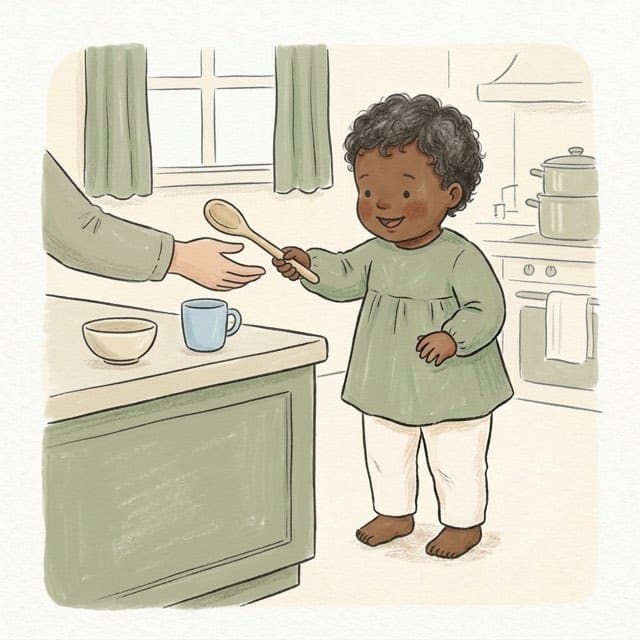
Spoon to Me

Keep a few safe things where they can reach. "Get the spoon and give it to me." Wait with your hand out, without pointing. Swap what you ask for each time.

Communication and Language · Physical · supports: following a two-step ask
Going out · 5 min

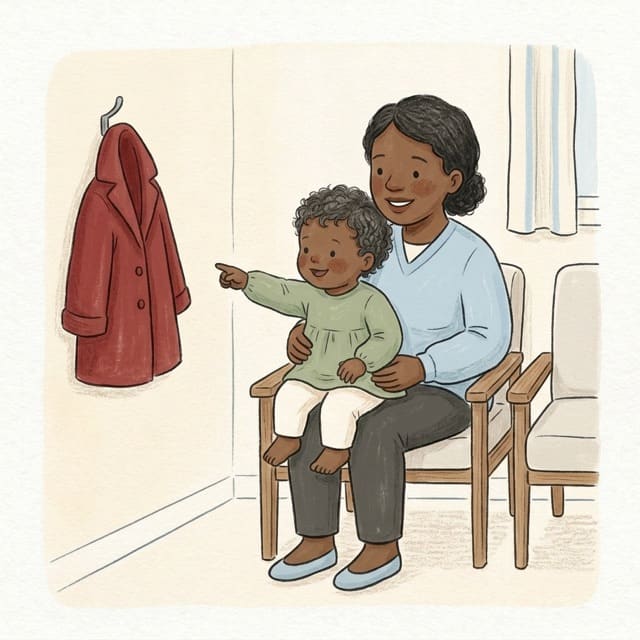
Coat by the Door

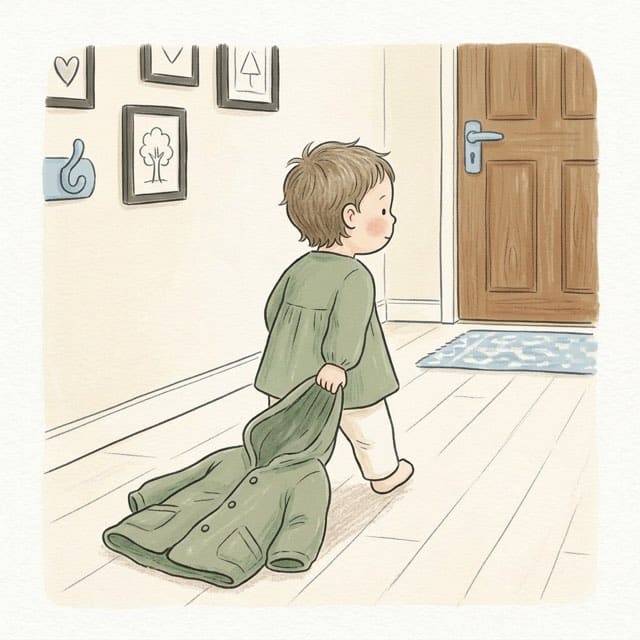
Say their name, wait for their eyes, then: "get your coat and put it by the door". Let them work out both parts without being shown.

Communication and Language · PSED · supports: following a two-step ask
The washing · 10 min

Whose Sock Is That?

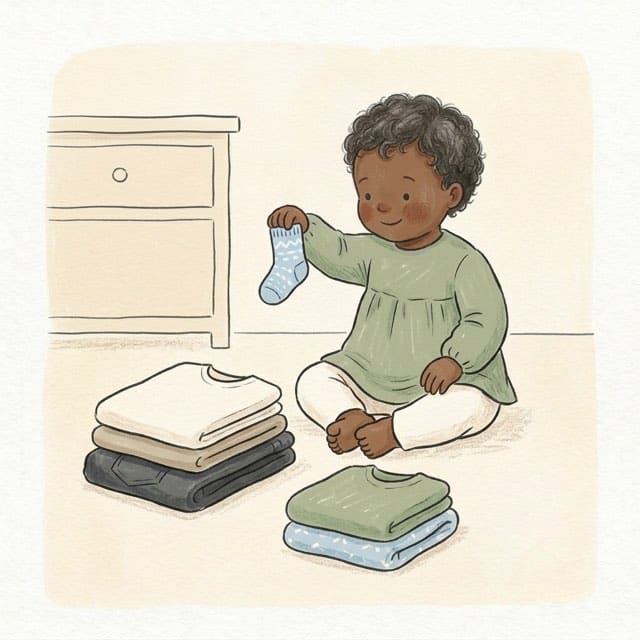
A pile for each person. Hold something up: "Daddy's sock". Hand it over to go on the right pile. When they say a name, add the thing back.

Communication and Language · Mathematics · supports: two words together
The walk in · 5 min

Counting Step Walk

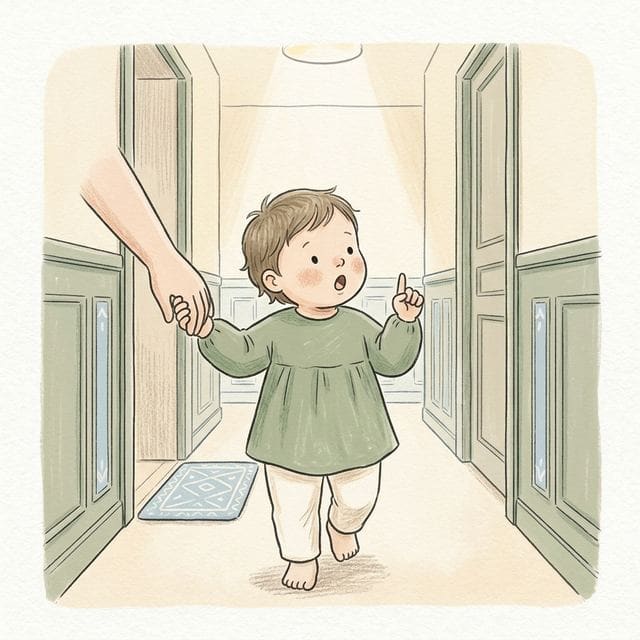
Hold hands and count the steps to the gate, one-two-three. Pause and ask how many to the next thing. Count backwards for the last few.

Mathematics · Physical · Communication and Language
The shopping · 10 min

Where Does It Go?

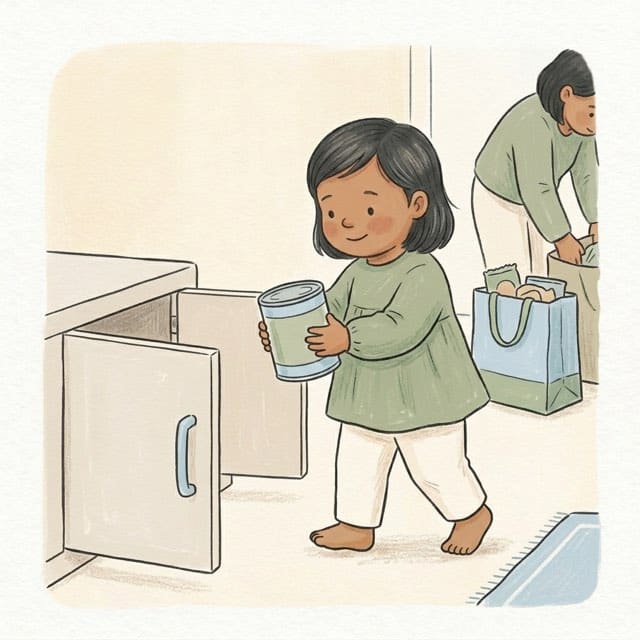
Unpack on the floor where they can reach. "Milk, fridge." "Beans, cupboard." Let them carry it there. Give every word back with the place added.

Communication and Language · Understanding the World
On the bus · 5 min

Spot the Red Thing

"I can see something red." Let them look round and point to anything red they can find. When they find one, they choose the next colour for you.

Communication and Language · Understanding the World

The sample pack is the first four weeks, laid out as the printed cards a family takes home, with the EYFS map practitioners would use on the last page.

Why it works

Nothing here is new to an early years practitioner. What is new is putting it together in a form a tired parent can do tonight.

  1. Tied to a routine. A habit sticks when it hangs on something that already happens. Bath time happens whatever kind of day it has been.
  2. Small enough to start. Five minutes is a yes. An afternoon of messy play is a no, every time, for a parent on a late shift.
  3. Introduced by someone they trust. Your staff see parents every day and are the people parents already ask. A leaflet from a stranger is not.
  4. Nothing to buy or print. So it is the same programme in every home, whatever the income.
  5. Measured properly. An independent early years evaluator measures play frequency, parent confidence and child development before and after, so what you tell Ofsted is true.

Who is behind it

Two of us, with a toddler at home and a clear split: one of us does the children, one of us does the technology.

Natalie Round, Programme Lead. A qualified primary school teacher (PGCE Primary, BSc Psychology) with ten years in the classroom, across every year group from Reception to Year 6. She teaches at St Joseph's Catholic Primary School in Sutton Coldfield, rated Outstanding, where she runs workshops for parents and works on closing the gap for disadvantaged children, and has taught in schools with many children learning English as an additional language and with SEND. She designs the programme, runs the starter sessions and the co-design with parents and practitioners, trains setting staff and writes the practitioner guide.

Blain Ellis, Project Director. A software engineer with more than ten years of experience, who built Little Wins: 824 illustrated activities for ages one to four, each tagged to the EYFS and to 34 everyday milestones, live on the App Store and Google Play since September 2026. He makes the packs, the translations and the check-in and summary tools, and holds the contract.

We are Brass Lantern Studios, a small Sutton Coldfield studio. CREC, the Centre for Research in Early Childhood in Birmingham, is our independent evaluator. We are looking for nurseries, schools and family hubs in Kingstanding, Erdington and Perry Barr for the first year, and we pay partner settings to review every card before families get it.

824activities tagged to the EYFS
34everyday milestones covered
5 to 10minutes an idea
£0to your setting or your families
Back the bid

Innovate UK and the Department for Education close applications on Wednesday 28 October. A one-paragraph letter saying you would take part makes the difference between a bid with one setting and a bid with a community behind it.

Backing us commits you to nothing until the funding is confirmed. If it is, the programme runs from February 2027, costs you nothing, and we do the work.

Or download a letter, add your setting's name and sign it: nursery or preschool · family hub or children's centre · childminder · primary school with a nursery or Reception

Questions, or want a quick call first? Email and Blain will phone you back the same day.